
Classical conditioning and operant conditioning are the two major experimental methods. These conditioning methods are widely used in psychology. The experiments define how behavior is learned, extinguished, and taught via associations and reward systems.
According to Empirical thoughts, human behavior is not learned randomly. Behavioural acquisition requires interaction and association with environmental factors. We learned any behavior through association and conditioning. Today, we are going to discuss the two main psychological experiments that have changed human perspective towards behavioral acquisition.
What is the conditioning?
Before learning about classical conditioning, we must familiarize ourselves with some psychological terms, e.g., conditioning, association, and stimuli.
Stimuli refer to anything that changes or modifies our reactions and behavior. For example, a snake ( an animal) is a stimulus that triggers fear responses when we suddenly encounter it. Likewise, a reward is a kind of stimulus that encourages and motivates us to perform specific tasks. Every object, situation, and factor that arouses our behavior and actions is known as a stimulus.
Association is a mental connection between two ideas, events, feelings, emotions, and mental states. Mostly, associations develop when two concepts are merged with meaningful connections. In simple words, association refers to a meaningful connection between two events.
Conditioning is the interaction between two stimuli. In psychology, conditioning is the learning process of modifying behavior via association with the environment. These environmental factors are known as stimuli
Classical conditioning
In the 1890s, a Russian psychologist, Ivan Pavlov, experimented on dogs’ digestive systems. Pavlou discovered that the dog responded to a neutral stimulus (bell) after conditioning with an unconditioned stimulus (food). Before conditioning, the dog has no connection with the bell. But when the bell is associated with the food, the bell becomes a conditioned stimulus (which aroused the salivation in the dog’s behavior). Before the bell was nothing to the dog; after associations, the bell became the main stimulus for the dog’s salivation. This experiment developed the concept of classical conditioning in psychology.
For a better understanding of classical conditioning, we need to familiarize ourselves with some terms
- Unconditional stimulus (UCS): Refers to a stimulus that triggers responses. For example, if food causes salivation, the food is the unconditioned stimulus (UCS)
- Unconditional response (UCR): Refers to our natural responses towards any stimulus. For example, food triggers salivation in dogs and other organisms. Here, the salivation is the unconditional response (USR).
- Neutral stimulus (NS): This is also a stimulus, but doesn’t trigger any response before conditioning. Simply, it doesn’t have any connection with the response or the organisms themselves before the association. For example, the bell was the neutral stimulus before conditioning it with the food.
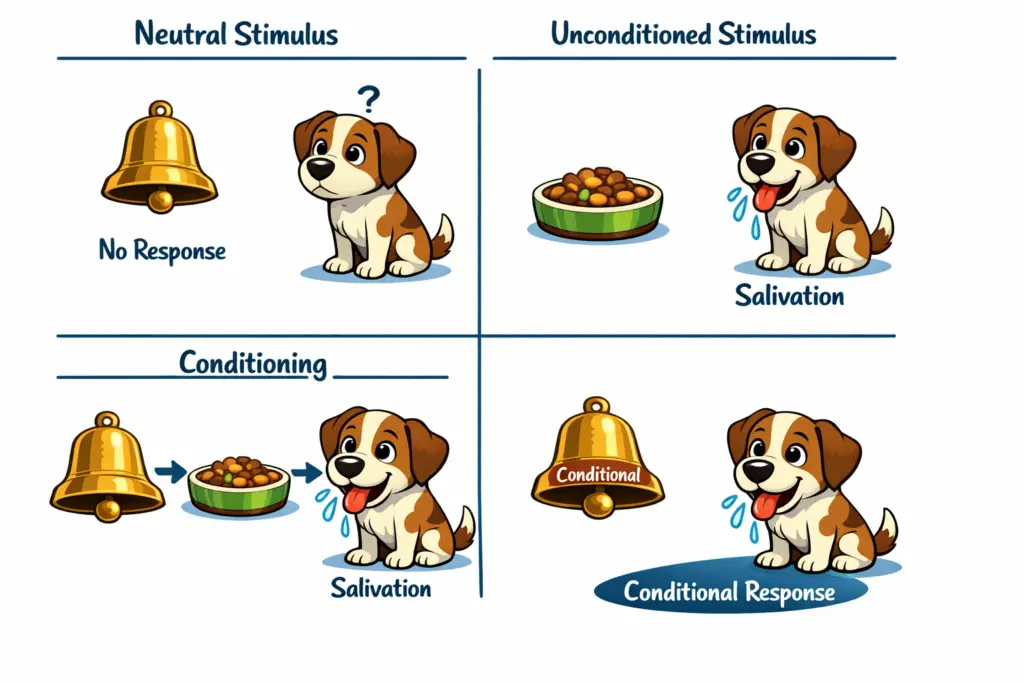
The food was a natural response for the dog, as the dog salivates when food is presented; the bell ring was a Neutral stimulus (NS) for the dogs. The dog wasn’t giving any response (salvation) to the ring before the association. After that, Pavlou rings the bell before presenting food, which creates an association between the bell and the food. After some repetitions, the dog starts to salivate when the bell rings. The bell ring, which was a neutral stimulus before, become conditional stimulus for the dog as it triggers the salivation.
Results of operant conditioning.
- The ring bell was a neutral stimulus for the dog before the experiment and conditioning, as it doesn’t affect dogs’ responses.
- The food was the unconditioned stimulus for the dog, as it triggers salivation
- The salivation was the unconditional response before conditioning.
- After repeated conditioning of food with a bell, the bell was converted from a neutral stimulus to a conditioned stimulus. As a result. The dog starts to salivate at the bell’s ring as well. Before conditioning, it does not affect the dogs’ response.
What is operant conditioning?
Operant conditioning is the learning process. In this process, the behavior is modified through its consequences. Such consequences include rewards and punishments. This conditioning method was developed in 1930.
Although the founder of operant conditioning is the American psychologist B.F Skinner, the basic concepts of classical conditionings arre picked from Edward Lee Thorndike’s (Law of effect). Thorndike discovered that a desired behavior is being followed by satisfactory consequences and rewards. That kind of behaviour has chances to repeat itself in the future. Likewise, those behaviors that are followed by discomfort and punishments are less likely to occur again.
Skinner box.
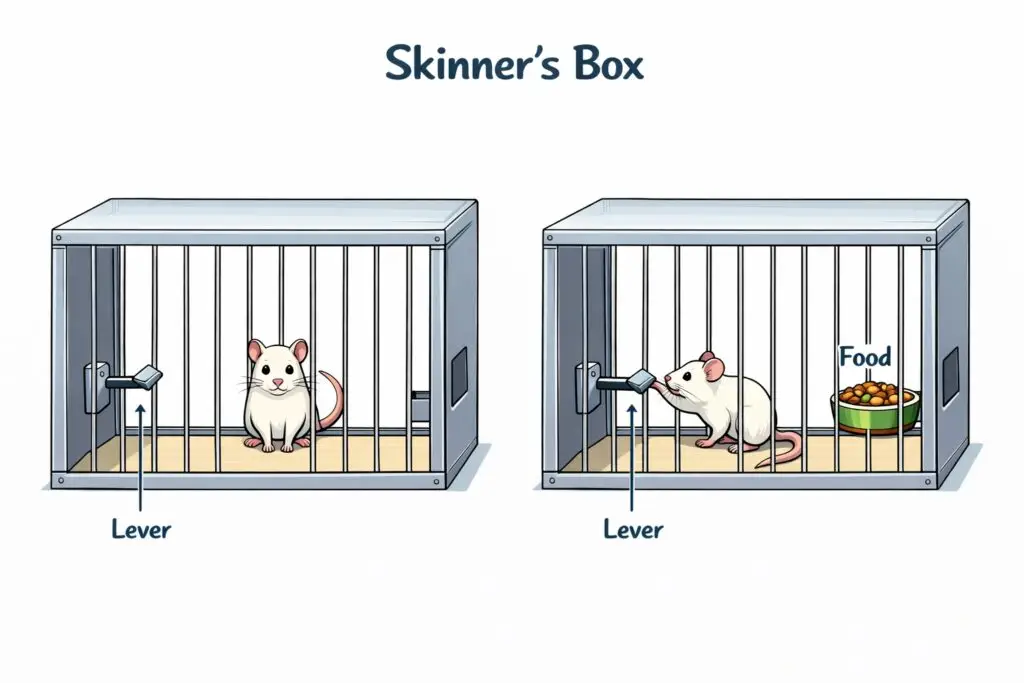
B.F Skinner conducted a controlled experiment on a rat to discover learning by consequences. Actually, he made a box (Skinner box), a cage where the rat could be placed. In the cage, there was an attached liver, with a path where the food was delivered, and an electrical shock in the floor.
When a hungry rat is placed in the box. First, the Rat was worried about what to do. Accidentally, Rat pressed the liver, and food was served in a specific way. Whenever that Rat presses the lever, food starts to be served. The rat intentionally started pressing the lever again and again when it needed the food. Finally, it learned that by pressing the lever, it would get food. In this experiment, the food was a positive reinforcement, which followed and strengthened the rat’s behavior (pressing the lever).
In another experiment, a rat was again caged in the Skinner box. This time, the rat was given an electric current. When the rat irritatingly ran inside the cage. When the rat accidentally touched the lever, the electrical current was turned off. As a result, the rat learned that pressing the lever would stop the current and provide relief (Negative reinforcement).
classical conditioning vs operant conditioning
| Aspect | Classical conditioning | Operant conditioning |
| Defination | learning through associations between stimulus | Learning through consequences. |
| Key psychologists | Ivan Pavlou | B.F Skinner |
| Famous experiment | Pavlous Dog salivation | Skinner Box |
| Focused behavior | Involunteer and automatic responses | volunteer behavior |
| Machanism | Stimuli associations | Reinforcement and punishment |
Punishments and reinforcement
Psychologists often conduct experiments on animals to study human behavior because, in most cases, we share behavioral patterns with other species.
So, operant conditioning introduced methods for modifying behavior. These four methods may include positive reinforcement, negative reinforcement, positive punishment, and negative punishment.
Positive reinforcement
The behavioral technique is used to strengthen the desired behavior by giving rewards and a pleasant environment, so that the behavior occurs again in the future. For example, the rat in the Skinner box has been given food as a reward for pressing the lever. Similarly, if a teacher praised a student for better performance in exams, it’s more likely that the student’s good performance might be repeated in future exams.
Negative reinforcement
This technique is also used to strengthen the behavior, but this time by removing unpleasant, unwanted, and undesired stimuli after the behavior occurs. For example, when the rat presses the lever in the second experiment, the electric current (which was an undesired stimulus) is removed. Let’s suppose that the same student who has performed well in exams was disturbed by a senior’s bullying. Controlling bullying behavior may strengthen the students’ future performances.
Positive punishment
In the process of punishment, we try to prevent the undesired behavior from repeating, while reinforcement tactics are used to strengthen the desired actions.
Positive punishment is the process of adding an unpleasant stimulus to decrease unwanted behavior after the behavior occurs. For example, punishing a student who abuses others in the classroom to avoid such behavior in the future. In this scenario, the punishment might be beating, which is a positive punishment for the student.
Negative punishment.
It’s also a technique of decreasing unwanted behavior, like positive punishment. But this time, the behavior is being decreased by removing a pleasant stimulus or a desired object immediately after the behavior.
For example, if a student fails in exams, the parents remove gaming, computer, and mobile devices, so that the student focuses on their studies. It’s a type of removing valuable objects, personas, and scenarios from our lives.
Reinforcement vs punishment.
| Concept | Goal | By | Example |
| Positive reinforcement | Increase desired behavior | Adding pleasant stimulus. | Praising a student for better performance in exams |
| Negative reinforcement | Increase desired behavior | Removing unpleasant stimulus | Removing bullying from a good student’s school life |
| Positive punishment | Decrease undesired behavior | Adding an unpleasant stimulus. | Physical punishment for an abusive student. |
| Negative punishment. | Decrease undesired behavior | Removing pleasant stimulus. | A mother usually ignores the child who misbehaves. |
Note. Many people mix the terms negative punishment and negative reinforcement. For that, you always need to remember.
In reinforcement, we always try to increase a desired behavior, and in punishment, we try to decrease unwanted behavior.
Conclusion. Operant conditioning vs classical conditioning.
Both classical conditioning and operant conditioning are essential theories for understanding learned behavior. These concepts are also important for a better understanding of behavioral modification in our own lives. Classical conditioning focuses on learning through association and is best illustrated by Ivan Pavlov’s dog experiment. The operant concept focuses on learning through consequences and is best illustrated by B.F Skinner’s controlled experiments. Together, these principles provide a strong foundation for understanding the formation, modification, and management of behavior in both humans and animals. These concepts laid the foundation for the behavioristic perspective. In the contemporary world, both concepts are used in education, research, psychology, animal training, and psychotherapy.